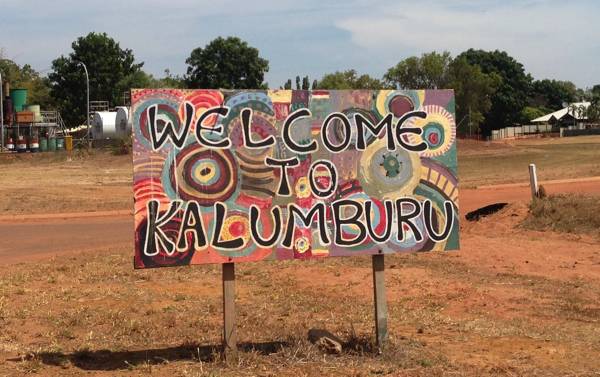
Its a pretty rough and dusty 200k drive north of Drysdale River Station where you will find the Aboriginal community of Kalumburu, its strange to drive into a town with new buildings and tarred roads when you know your in one of the most remote parts of the country.
 Kalumburu on the banks of the King Edward river is the most northern settlement in Western Australia, the first white people to arrive in Kalumburu was 1901 when the first mission was established a bit further north at Pago. Pago is now just ruins since the mission was relocated to its current location in the 1930s, a move that took five years with donkeys and carts. The locals gave the visitors a hostile reception but things settled down with a shotgun being fired before many locals walking in from the bush to see what was going on and joined in the community.
Kimberley is loaded with stone, large stone which was used to build a monastery that still looks as good today as in 1930s. In 1942 Kalumburu became a frontline RAAF base for World War II when the military took over the mission.
From the info supplied by the Kalumburu Aboriginal Corporation
“In the same year (1942) members of the community led by Father Thomas Gil played a major role in the rescue of the 130 survivors from the bombing of the state ship Koolama near the mouth of the King George River.”
“On 27 September 1943 Kalumburu sustained a major assault by Japanese bombers, wreaking havoc and costing six lives including Mission Superior, Father Gil.”
We pulled into the mission store next to the monastery looking to purchase our permit that allows us to be in the aboriginal reserve, other than the lady behind the counter we were the only white people in sight, our skin colour is very dark right now but not quite that of the locals. The mission store lady told us we would need to purchase our permit from the main store next to the centrelink office. Signs all over town remind everyone that Kalumburu is a dry town NO ALCHOL, good for the locals health but we have 10+ cartons between us so not great for us. We drove around the corner and found the place with 50 or 60 locals sitting around doing little in the heat.
After paying for our permit and buying some expensive supplies we headed north to McGowan Island a beach owned but he KAC where you can camp right on the beach, no power, no phone, no internet, no TV and no hot water (it had toilets), its a great place for a holiday. Robert greeted us (if thats what you could call it) he was a tad gruff but we got to choose the best site down on the beach so we were happy. We set up camp and went for a walk along the beach to look for crocs, sharks and oysters on the low tide.
 We had a great week at Kalumburu fishing, resting and living in the wild, I even made a spear and went hunting with it, we tossed some fish frames that we got from Frank Albanese from Traralgon in the water to atract fish to spear. We waited patiently for far to long but no fish arrived… until four sharks turned up looking for a feed, 2 sharks were harmless and tried to suck on the fish (we didn’t try to spear them) but a couple of tiger sharks turned up and moved in. Jim speared one of the fish frames out of the water and tied it to a rope before tossing it back in. We didn’t have fishing gear on us to handle a 3 meter tiger shark so the rope seemed a good idea at the time.
Before long the fish frame rope sitting only a few meters in front of us took off quickly in the sharks mouth, I could see the surprise in Jims eyes at how quick it went so I grabbed the rope to help, no chance and a bad choice the tiger shark ran around 10 meters in quick time and my hand had no chance of holding it, all I got was a burn mark on my fingers. The shark spat the bait soon after and took off but gee it was great to feel its amazing force for a few seconds.
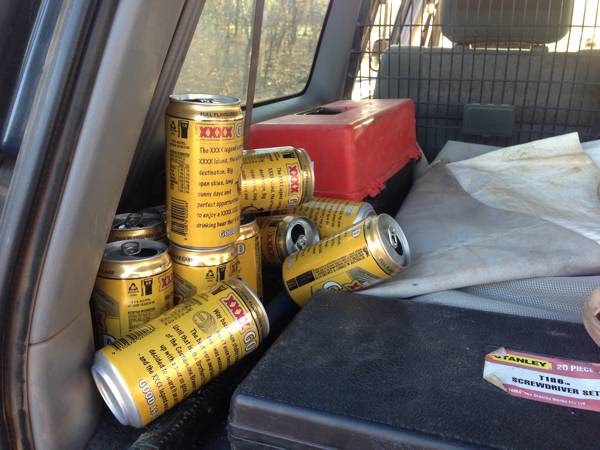 A couple of days into our trip we went 7ks north to Honeymoon Bay the only other place you can camp at Kalumburu and hunting for wood for our nightly fire. Honeymoon Bay had a good beach but a poor camp ground so we were happy in our choice back at McGowan Island. On the return trip we collected enough wood for the rest of the week and had a beer to mark the spot, yeah I did say the place allows no alcohol but thats not for everyone is it? We enjoyed more than a carton between the four of us over a couple of hours and it turned out to be a very fun and funny afternoon with Jim and Maxine. The only time we paused was when a vehicle approached us on the dusty track so we hid the evidence and told them we were looking for wood, then continued on drinking when they left, we did see a few of them later that night and knew what we were up to and found it very funny.
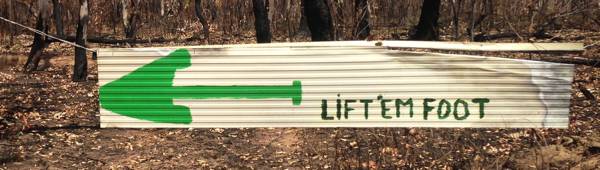
On the track back from Honeymoon Bay before we stopped for a beer (I mean collect firewood) on a bend and a dip a large sign says “LIFT’EM FOOT” blonde moment #1455 happened…
It was obvious to the boys in the car (and maybe the other blonde) that “lift’em foot” was aboriginal for “slow down” But Shelly had to ask and and instantly got it before laughing her way through BM #1455.
Fishing at McGowans was great on the first day and ok on the second but after that it was no good, maybe because of all the sharks and the resident croc? But we got plenty of fish given to us by the people with boats who had plenty to share.
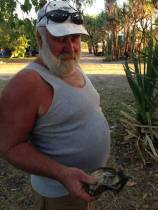 We met plenty of interesting people at McGowan Island Lindsay and Marg from Shepparton were funny, I helped her with her computer whilst Lindsay set up his satellite tv and generator before watching every minute of every game for the weekend. Frank Albanese and his wife had traveled much of WA and still only in there early 20s. Mick an older guy from Queensland had a van and boat set up on the beach and he went fishing every day, thats seems normal but Mick had recently had a stroke and his family had tried to put him in a nursing home so he packed up and left for the Kimberley where he’s living a great life in paradise. Mick struggled to get around with any great pass but could manage anything we could, he was cutting wood with one hand and dragging his esky over to his boat before pushing it off and away he went. Another Tasmanian we referred to as Dad because he was of similar appearance to Jim just lots older (turns out he wasn’t much older just looked it) Dad and Mum (Dads wife) joined us a couple of nights around the fire and shared a few stories mum was always enjoying herself NOT, she didn’t smile much as she coughed her way through a packet of smokes.
We spent six nights and could have stayed for six months up the Kimberley’s north, Shelly asked Robert the guy who ran the place for his job but he laughed and told her he’d been here for 29 years and would be here for 20 more. We watched Robert in action one day when he had a heap of locals out staying with him. He tossed his cast net into the water and pulled it out with at least 50 live baits then he and his mates jumped in the boat and went a few hundred meters off our beach, we could hear heaps of noise coming from the boat before they returned with a boat load of fish one was a meter long and half a meter wide that must have weighed in at 30 kilo, we enjoyed some of that mulloway for dinner that night.
Most of the guys who went fishing went far far away, well out of sight of the beach but the local aboriginal dropped anchor just of the beach and cleaned up.
On our way out of town we found the plane wreck from WW2 it was broken into many pieces and the engine was ripped apart but it wasn’t rusting away or anything it didn’t look so bad other than it was ripped in to a few pieces.
What an amazing place it was sad to leave, we are heading back down the dusty and bumpy track for Mitchel Falls.


 CameronCorner